Bull Appraisal
Soon after, a calf is born it is tagged using a tissue tag that allows us to extract the DNA. The DNA is sent to the Neogen whose Igenity profile determines sixteen performance traits, resulting in Maternal, Growth and Carcass results. Only bull calves that are in the top 10% of the National Highland herd are kept as bulls. All other male calves are castrated.
Having passed the DNA test, if the bull calf was born unassisted and we think it has the potential to be raised as a bull, the next check is to look at the mother’s feet and udder. If the feet are not perfect and the mother does not walk well, then the calf should be castrated.
The udder and teats are each scored 1-5, one being the best and five being long, thick teats and a badly shaped udder. An older, well-performing cow with four good quarters may get away with a score of two, otherwise, a score other than one would result in the calf being castrated.

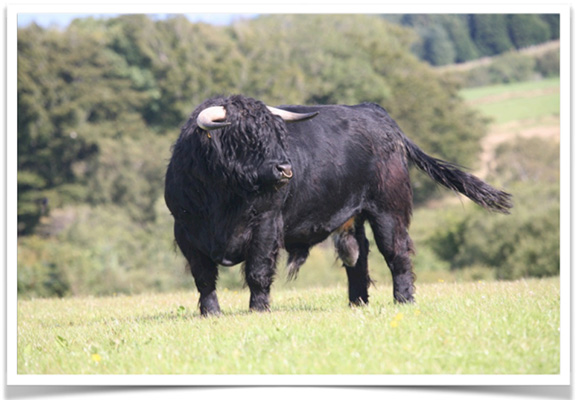
Calum Seoladair Dubh 2nd of Killochries. Semen available internationally from this bull.
If the calf passes the above tests, we would run the calf with the herd and without any special treatment, like creep feeding, so that performance figures are not distorted. Our bulls and their calves have to perform on the hill and force-feeding will distort our ability to measure their potential to perform in this environment.
Weighing at 200 days will predict the bull’s ability to produce daughters with a high milk yield that will, in turn, give their calves the best start whether pure bred or crossed.
Weighing at 400 days will give, along with the 200-day weight, the ability to predict improved carcass size.
A target worth setting is that the bull should reach 45% of his mother’s weight at adjusted weaning. If the adult female weight was 500 kg, then we would aim for 250 kg calves at weaning. The adjusted live weight gain, from birth, should be in excess of 1 kg per day.
Larger scrotal circumference, while giving an indication of fertility, more importantly, will produce earlier maturing females. A spring born female weighing 400 kg at 27 months is ready to bull and will produce a calf at three years old, a year earlier than most heifers in the Highland herd.
Having survived the above, the bull can now be appraised. Ultrasound scanning at 400 days is the most accurate way to determine the muscle and back fat but unless you are performance recording with Signet, is an overkill. Muscle can be assessed visually and fat assessed by feeling for the dimple in the middle of the back or excess fat on the tail head.
The breed standard is available on the society’s website and should be adhered to. Horns, in particular, should come straight out and then rise. Bulls with horns turning down will produce heifers with flat heads or, even worse, with down horns.
Length, rib, straight back and flat even, well-muscled plates are the hallmarks of successful bulls but at the end of the day, he must walk well, you must like him, he must be easy to handle and have a quiet docile temperament.
A good solution for a new breeder with no more than eight cows is to buy a high performance bull calf and use him at fifteen months old. Buying him as a calf will allow you to work with a smaller animal, he will get very used to you and you have the possibility of recovering your investment by selling him on when he is coming on to his own line but still young enough to demand a premium.
Iain Graham
Sales
You might like to view our Bulls for Sale and see what Semen Straws and Embryos are available worldwide
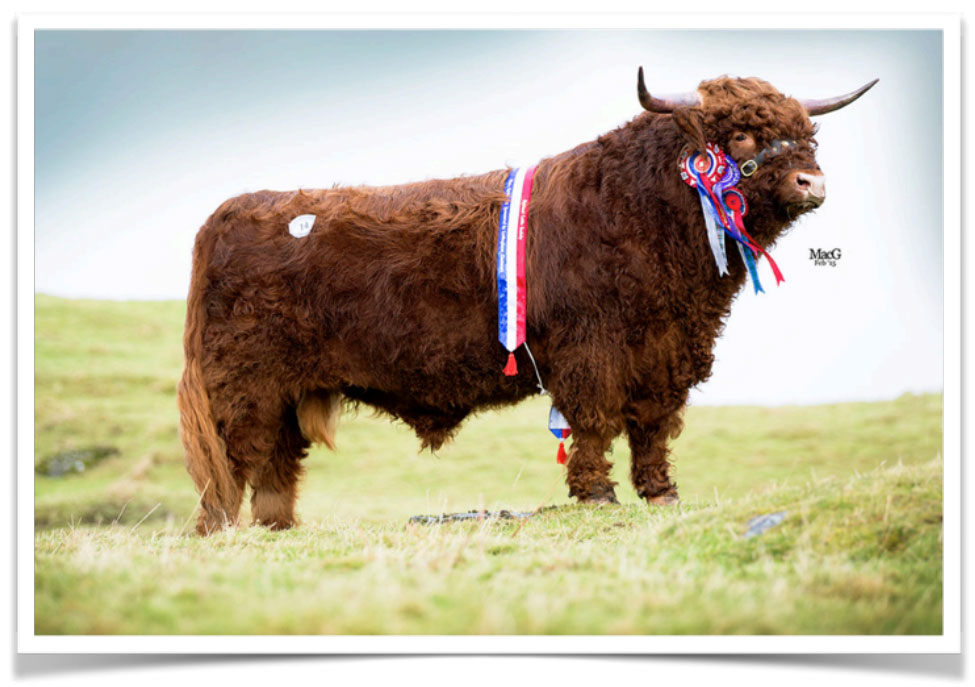
Sean 2nd of Killochries, Champion Oban 2015 (above).